Project
Bitcoin Heating System - Product Lessons from Zero to Production
The views and lessons shared here reflect my personal experience and do not disclose confidential company information.
This Was My First Real Hardware Product
Before this, I had never shipped commercial hardware to customers.
I had done hobby projects. I had done academic hardware work from my electrical engineering background. I was comfortable building things. But that is not the same as taking a physical product all the way to production and putting it into other people’s homes.
No manufacturing background.
No certification experience.
No thermal engineering background.
No supply chain experience.
What I did have was product experience, systems thinking, and maybe a slightly dangerous level of confidence that if you understand tradeoffs well enough, you can learn your way into almost any domain.
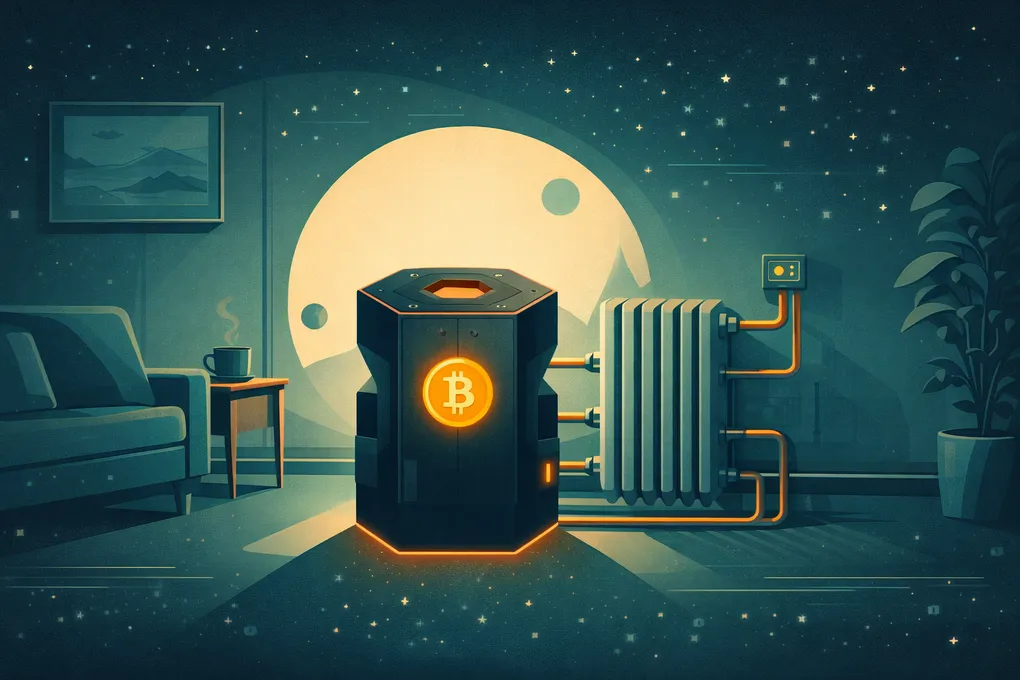
The product was a Bitcoin Heating System.
A device that uses electricity twice:
- First, to mine Bitcoin.
- Second, to heat a home with the generated thermal energy.
Instead of wasting the heat from computation, we redirected it into a real-world utility.
The ambition was simple, maybe a little naive, and definitely bold: build a heating system that could partially pay for itself over time while still feeling like a modern connected device, not a piece of ugly industrial equipment someone tolerated in the corner.
This is the story of taking that idea from zero to production, and all the things I learned the hard way on the route there.
Vision and Strategy: Direction and Execution
Before prototypes, before partners, before technical debates, I defined both a product vision and a strategy.
You need both.
Vision gives you direction.
Strategy gives you execution guidelines.
An idea without execution is just optimism.
Execution without vision is just motion.
1. Vision — Why This Should Exist
The vision was bold and simple:
Every household in the future can become a productive node.
Instead of concentrating compute in massive centralized facilities and wasting heat, we decentralize computational power — Bitcoin mining today, potentially AI workloads tomorrow — directly into homes.
Homes already need heat.
Compute already produces heat.
Combine the two.
Electricity should not be wasted.
If computation generates heat, that heat should be useful.
And if a device consumes power anyway, it should create economic value.
This was not just a heating device.
It was a heating system that earns money while running.
We were not optimizing only for thermal output.
We were optimizing for decentralized value creation.
2. Strategy — How We Make It Work
Strategy was not only about technical optimization. It was also about sequencing, capital efficiency, and market execution.
We aligned early on a few execution principles:
- Build the first functional prototypes fast.
- Install them in controlled environments.
- Use real-world performance to validate assumptions.
- Launch pre-sales to finance the next development cycle.
- Expand the product line in stages rather than all at once.
- Decide consciously which markets to enter first, second, and later.
- Work with installation partners who could scale with us.
- Re-evaluate strategy regularly against utilization, reliability, and cash position.
We agreed on this path and stuck to it, adjusting based on data rather than emotion.
Once the vision was clear, the strategy had to translate it into measurable execution.
Our North Star was simple:
Utilization rate of the system.
The more it runs, the more it:
- Heats
- Generates Bitcoin
- Improves ROI for the customer
High utilization meant high value.
That metric became the anchor.
Whenever we debated design, cooling architecture, software behavior, or installation constraints, we asked:
Does this increase sustainable utilization?
From that point forward, many decisions became obvious:
- We optimized for efficiency rather than short peak bursts.
- We preferred stable lower power operation over aggressive spikes followed by idle time.
- We looked for additional heating sinks when the house itself was already warm.
- We redirected excess heat into storage buffers where possible.
- We built remote monitoring to prevent downtime.
Everything pointed back to one principle: keep machines running safely, consistently, and efficiently.
Lesson learned: Vision without strategy drifts. Strategy without vision fragments. You need both — and you need a measurable North Star to connect them.
Entering a New Domain Blind
Software was not new to me. Heating systems were.
And heating is messy.
Every building is different.
Every installation behaves differently.
Fluid dynamics, thermal inertia, pump sizing, pipe diameter — everything interacts.
At the beginning, I underestimated how deeply a product leader must understand the domain.
I had models.
I had calculations.
I had assumptions.
What I did not have was lived intuition.
I had to build that from scratch.
Lesson learned: A product leader cannot outsource domain understanding. If you don’t understand the system, you cannot make good tradeoffs.
If I did it again, I would immerse myself earlier and deeper — shadow installers, break things intentionally in controlled environments, observe failure patterns firsthand.
- Every house is different - https://ry3t.com/2025/01/09/der-erste-ry3t-one-heizt-ein-komplettes-einfamilienhaus/
The Beautiful, Expensive, Inflexible Prototype
Our first serious prototype was built with external support.
It looked structured. It looked engineered. It looked “serious.”
It was also rigid.
When we needed to change a pump, adjust pipe dimensions, replace sensors, or increase compute density, modifications became slow and expensive.
We depended on external specialists to change basic components.
Every iteration required coordination, cost, and waiting.
That is deadly in a startup.
Eventually, I made a decision: build a stripped-down version myself.
It was modular.
It was simple.
It was adjustable within hours.
It was not pretty.
But it accelerated learning dramatically.
Lesson learned: early prototypes have to optimize for learning speed, not aesthetics.
Modularity beats perfection.
- Test environment: https://ry3t.com/2024/07/03/ry3t-auf-dem-pruefstand
Product vs Project — The Real Divide
One of the biggest insights from this journey was the difference between project thinking and product thinking.
Some partners approached it as a project:
- Define all requirements upfront
- Freeze scope
- Execute in phases
- Deliver at the end
I approached it as a product:
- Requirements evolve
- Unknowns are expected
- Iteration is constant
- Learning is the output
A project optimizes for completion.
A product optimizes for adaptation.
Hardware engineering defaults to project mode.
Startups cannot afford that.
Lesson learned: If you treat an innovative hardware build like a traditional project, you will either move too slowly or freeze too early.
When Money Runs Out, Focus Appears
In the beginning, we had relative comfort.
Later, we did not.
Capital constraints removed ambiguity.
When runway shrinks, clarity increases.
We had to ship something functional.
Fast.
So we assembled working systems using simplified configurations and installed them in controlled environments.
Not perfect.
Not fully optimized.
But functional.
And that changed everything.
We started gathering real operational data.
We saw real-world behavior.
We improved software remotely.
We validated demand.
Lesson learned: scarcity forces prioritization. Comfort delays truth. Ship something embarrassingly fast, learn from day 0, do not be reckless, and make sure you define clear safety boundaries around anything that cannot afford to break.
- First prototype installation - https://ry3t.com/2024/09/15/einblicke-in-die-erste-ry3t-one-installation
Calculated Risk, Not Recklessness
Deploying early hardware into real environments sounds risky.
It can be.
But speed does not mean irresponsibility.
We:
- Deployed in controlled settings
- Monitored systems remotely
- Built rollback paths
- Avoided compromising safety-critical components
We accepted bounded risks in order to learn.
That is very different from gambling.
Lesson learned: Bold execution must be paired with explicit risk boundaries.
Especially in infrastructure-adjacent products.
Partner Fit Is Strategic, Not Operational
Our first manufacturing partner was misaligned.
Technically capable.
But slow. Expensive. Iteration-resistant.
We changed partners.
And we changed the rules:
- Designs belonged to us
- Documentation was internal
- No single partner could block progress
That decision created optionality.
Lesson learned: never let a supplier relationship define your strategic flexibility.
IP ownership is not ego. It is leverage.
- First production - https://ry3t.com/2024/09/11/die-produktion-der-ersten-ry3t-ones
Oil vs Water — Technology as Strategy
The original design used immersion cooling.
Thermodynamically efficient.
Operationally complex.
Maintenance issues and leakage risk surfaced over time.
We later pivoted toward water cooling:
- Slightly lower efficiency
- Significantly lower maintenance risk
- More scalable manufacturing path
We effectively ran two tracks:
- Continue generating revenue with the existing design
- Invest in a more sustainable long-term architecture
Lesson learned: technology decisions are strategic bets. Evaluate them on long-term risk, not just short-term performance.
If I could redo this phase, I would prototype competing technologies earlier before committing.
Remote Operations Changed the Game
Once multiple units were running, operations complexity increased.
We built:
- Centralized monitoring dashboards
- Remote update capabilities
- Proactive alerting systems
Without remote visibility, hardware becomes unpredictable at scale.
Lesson learned: serviceability and observability are product features, not operational afterthoughts.
If your product lives in someone else’s physical environment, remote control is not optional.
Communication in Chaos
Startups are messy.
We used simple communication tools.
We defined clear ownership.
Weekly cross-functional syncs aligned sales, product, and operations.
Internally, I used a simple health status model:
- Red: critical, blocking
- Orange: not going according to expectations
- Green: all good, we are on track
Lesson learned: In high uncertainty, clarity of responsibility matters more than process sophistication.
Ceremony does not create alignment. Ownership does.
- Previously I built health statuses at Productboard - https://support.productboard.com/hc/en-us/articles/15046240330259-Provide-health-updates-for-your-features
Emotional Resilience Is Part of the Job
There were moments of pressure.
Responsibility is different when people depend on you.
When resources tighten and uncertainty increases, emotional steadiness becomes a leadership skill.
Lesson learned: Calm under pressure is not personality. It is discipline.
What I Would Do Differently
- Immerse in domain knowledge earlier.
- Prototype competing technologies before committing.
- Design modularity from day one.
- Shorten validation loops further.
- Challenge partner fit faster.
What This Experience Proved
I took a Bitcoin Heating System from almost zero to production.
Without prior commercial hardware experience.
In a new technical domain.
With capital constraints.
With real-world deployments.
But the real achievement was not the hardware.
It was learning how to:
- Anchor decisions in vision
- Think in systems
- Distinguish product from project
- Take calculated risks
- Pivot strategically
- Extract lessons from mistakes
The hardware was the vehicle.
The mindset was the real asset.
If you are building something outside your experience:
You do not need certainty.
You need vision, speed, discipline, and the willingness to learn aggressively.
Zero experience is not a blocker.
Stagnation is.
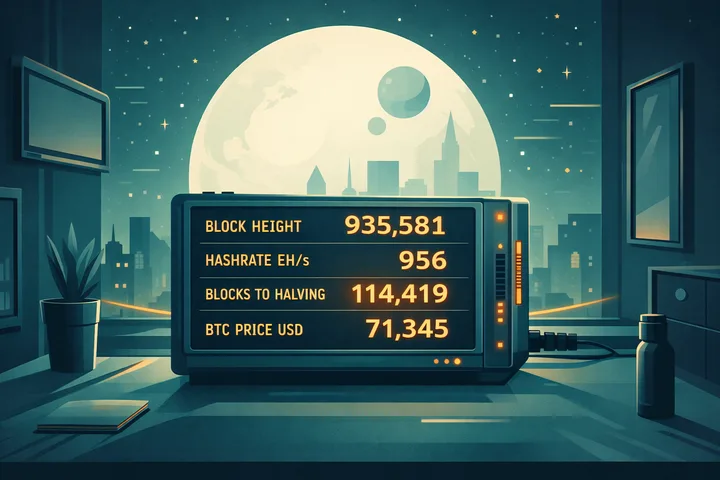
From Block Clock to Freedom Clock - The Metric That Finally Clicked
I built a Bitcoin block clock because protocol time fascinated me. Then I rebuilt it into something that made more sense to my actual life: a Freedom Clock that measures runway, saved time, and what Bitcoin is really buying me.