Blog
Bitcoin - The brand nobody built and everybody owns
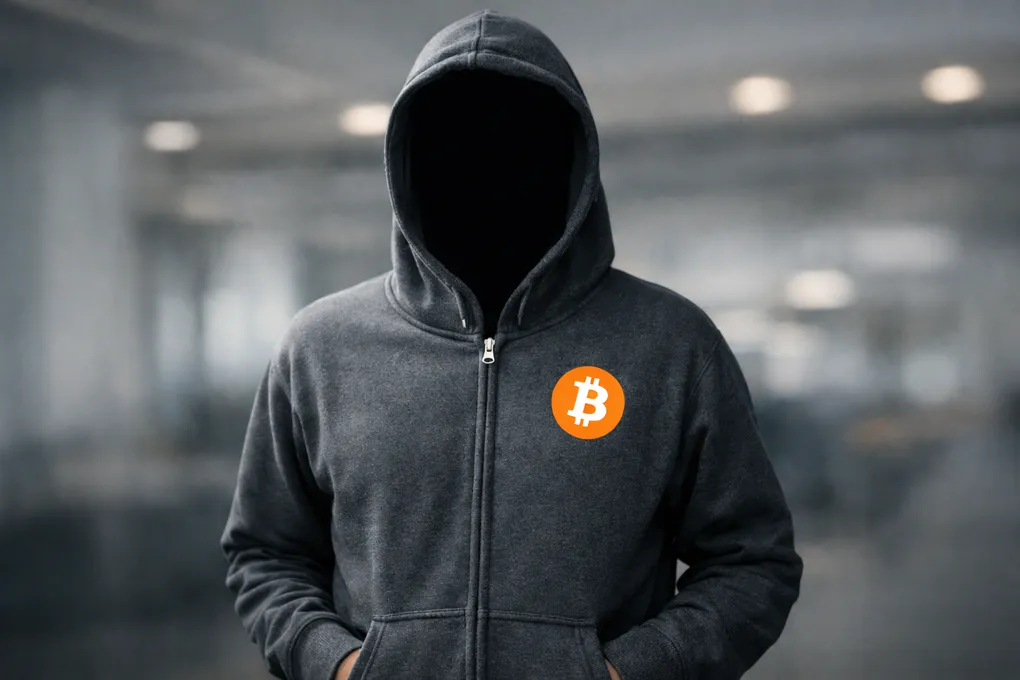
Here’s the thing about spotting a Bitcoiner in the wild: most of the time, you can’t.
There is no uniform. No reliable dress code. Usually no bumper sticker either. Many long-term Bitcoiners are private by instinct — low-profile and not especially interested in broadcasting themselves. Privacy is a value in Bitcoin circles, not some optional add-on. You do not advertise what you hold. You do not make yourself a target. Most of the people I know who take Bitcoin seriously look like everyone else at the coffee shop, on the train, or in a meeting room.
Which is exactly why the rare visible moments hit so hard.
A few years ago, I was waiting for a flight at Zurich airport when I noticed an orange sticker on the laptop of the person next to me. Just a circle with a ”₿” inside, tilted slightly to the right. Nothing else. No company name. No slogan. No URL.
I knew what it was immediately. I smiled. We made eye contact. He nodded.
That was it. Two strangers, different countries, different ages, briefly connected by a sticker most people in that terminal would not even notice. It worked because those moments are rare. Bitcoiners usually do not give themselves away. When they do, something clicks.
I had been around Bitcoin long enough to know that feeling well. What took me longer to understand was why it works at all. For that, I needed a different set of eyes.
For a while I worked at Frontify, a brand management software company. That job put me in conversations with brand leaders at global companies — people who think for a living about logos, visual systems, tone of voice, consistency, governance, all of it. I was a product person trying to understand their world. But the longer I listened, the harder it was to ignore one thought:
Bitcoin somehow does many of the same things, without any of the machinery those companies rely on.
Marty Neumeier, in The Brand Gap, defines a brand with unusual precision: it is a person’s gut feeling about a product, service, or company. Not a logo. Not a tagline. A feeling that lives in the mind of the audience, not the hands of the company. Bitcoin might be the purest expression of that definition I have encountered, because there is no company to shape the feeling. What you feel about Bitcoin is entirely your own.
I am not a brand strategist. But I learned enough to start looking at Bitcoin through that lens. And what I see is strange enough to be worth explaining — especially for people trying to understand Bitcoin as something more than a volatile line on a chart.
So this is what this piece is: not a technical explainer, not an investment pitch. Just a look at Bitcoin as a brand, because that angle reveals more than people think.
The founding story no agency could have scripted
Every strong brand has an origin story. The memorable ones usually sound improbable. Bitcoin’s still feels strange even if you know it well.
On October 31, 2008, someone using the name Satoshi Nakamoto sent a nine-page paper to a cryptography mailing list. It described a new kind of money — something that could move between people without a bank in the middle. No launch event. No PR build-up. Most people ignored it. The people who did not ended up changing their lives around it.
The network went live on January 3, 2009. In the first block ever mined, Nakamoto embedded a newspaper headline: “The Times 03/Jan/2009 Chancellor on brink of second bailout for banks.” One line, dropped into the chain forever. The point was already clear. It was not subtle.
By 2011, Nakamoto was gone. No press interview, no retirement speech. Just an email to one collaborator saying “I’ve moved on to other things,” and silence that has now lasted over a decade.
Here is the part I keep coming back to: Nakamoto is believed to have mined somewhere around one million bitcoin in the early days — a figure from blockchain analysis, not a confirmed fact. At current prices, that would be well over a hundred billion dollars. The addresses commonly attributed to Satoshi are widely believed to have remained untouched, visible to anyone who wants to check. The person who built Bitcoin has never been seen to extract value from it. That is a strange and remarkable thing to say about the founder of anything.
A logo born in a forum post
Big companies spend an absurd amount of time on logo governance: the right size, the right color, the right context. Entire software categories exist to manage that problem. Bitcoin has none of that — and still ended up with one of the most recognizable symbols on earth.
Nakamoto designed the first logo in 2009. Then, in November 2010, a user on the BitcoinTalk forum called “bitboy” posted a new version: a white ₿ on a flat orange circle, tilted about fourteen degrees clockwise. The post was casual — something like “Hi guys, just dropping by to share some graphics I made.” He shared it freely. No central brand owner, no approval process. Just: here, use it.
That throwaway forum post is the root of the symbol you now see on ETF tickers, hardware wallets, exchange apps, and the financial pages of major newspapers.
The orange works because it reads clearly across digital and print, and to me it suggests something warm and metallic without being literally gold. The commonly used hex is #F7931A. Millions of people apply it consistently across products and websites without ever reading a brand guideline. The Bitcoin sign entered Unicode 10.0 in 2017, formalizing a symbol that was already widely used. There is no central owner policing what counts as authentic Bitcoin branding — in practice the community treats the name and symbol as publicly owned.
What I find interesting here — and I could not have framed it this way before Frontify — is that the symbol does what the best brand marks do: it makes an abstract idea instantly visible. You see the orange ₿ and you know what world it belongs to. Plenty of companies with full design departments never achieve that clarity. Bitcoin got there through a forum post.
The culture is the brand
This is the part I most want non-Bitcoiners to understand, because from the outside it looks strange, and from the inside it makes perfect sense.
Bitcoin does not have a brand in the traditional sense. It has a culture. And in this case, the culture is the brand — more completely than almost anything else I have seen.
Many long-term Bitcoiners tend to be private — and that is not accidental. The culture grew out of cypherpunk roots, people who treated privacy as a principle. Do not advertise what you hold. Do not make yourself a target. So most move through the world without a badge or a signal.
Which raises an interesting question: how does a community with so few visible signals still recognize itself?
Mostly through conversation. And usually through one question.
When two Bitcoiners meet for the first time — usually by accident, through a book reference or a suspiciously specific opinion about money — the first real question is almost always: “When did you get into it?” Not how much do you have. Not where does the price go next. Just: when.
That date tells you a lot. Which crashes they lived through, which hype cycles, which moments made them doubt it. Someone who found Bitcoin in 2011 carries different experiences than someone who arrived through an app in 2020. Both count. But the date is shorthand for the journey.
I have had that conversation dozens of times. It skips the small talk in a way that almost feels rude, until suddenly you have been talking for two hours about monetary history, geopolitics, and the long tail of 2008. There is an instant grammar to it — you start from shared first principles and go from there.
What nobody asks, ever, is how much someone holds. It is bad form, a security risk, and beside the point. The Bitcoin social contract runs almost opposite to what you would expect from a community organized around an appreciating asset. Less “look what I have,” more “look what I understand.” The ostentatious-Bitcoiner era of 2017 was real, and many who stayed through the crashes that followed stopped caring about those status markers.
The transformation many serious Bitcoiners describe — and I have gone through some version of it myself — follows a familiar pattern. You come in for the price. You stay for everything else. You start reading about monetary history, how central banks work, why your savings keep leaking value even when you are doing everything right. Somewhere along the way, price stops being the interesting part. Time becomes the interesting part. The community has a phrase for this: “low time preference.” Thinking in decades instead of quarters. The writer Gigi put it simply: “You won’t change Bitcoin, but Bitcoin will change you.” I have watched that happen to people I know.
Neumeier calls what forms around brands like this a tribe — people who share not just a product preference but a worldview. Tribes do not need advertising. They grow through recognition. Every “when did you get into it?” conversation is that recognition happening without a campaign, a budget, or anyone in charge of it.
The protocol is the brand promise
Most brand analysis of Bitcoin stops at symbol, story, and community. But underneath all of that is something I think gets underappreciated: the product itself keeps making the same promises, and then keeps them.
Fixed supply: 21 million bitcoin, written into the protocol, enforced by every node on the network. Predictable issuance: new coins arrive on a schedule anyone can verify. Leaderless governance: no single person or company can change the rules unilaterally. And a public record going back to January 3, 2009, with its monetary rules preserved across crises, bugs, forks, and attacks.
In conventional brand terms, the product validates the story. In Bitcoin, the protocol validates the brand. Every four years the block subsidy halves, exactly as designed. Roughly every ten minutes on average, a new block is added, regardless of what is happening in the news. The system does not need a press release to say “we are still here.” It just keeps running.
This explains something that would otherwise be hard to account for: why Bitcoin’s brand has survived crashes, bans, the departure of its creator, and the constant arrival of competitors claiming to be better. The identity holds because the underlying behavior is consistent. A brand built on culture alone eventually drifts. Bitcoin’s culture is anchored to a protocol that does not.
What nobody owns, everybody protects
There is no central authority deciding what counts as authentic Bitcoin. Hard forks have tried to split the brand — Bitcoin Cash, Bitcoin SV, others. They mostly failed. Not because anyone shut them down legally, but because the community rejected them. The cultural immune system held.
Rich Feldman, a brand consultant who has written about this, calls Bitcoin a “User-Generated Brand” — shaped entirely by its community with no central owner. When someone asks “what cryptocurrency should I buy?” the first expected answer is not nuanced analysis. It is Bitcoin.
That framing works, but only up to a point. Traditional brands get their consistency enforced top-down. Bitcoin gets it enforced bottom-up — by millions of people who will, unprompted, correct you for conflating Bitcoin with crypto in general. That is a different kind of protection, and in some ways a more durable one.
Most brands are managed into coherence from the top down. Bitcoin reached coherence from the bottom up.
The brand gap runs both ways
Neumeier’s book is about the distance between what a brand claims to be and what people actually perceive. Bitcoin has that gap running in two directions at once.
From the outside, some of the most persistent criticisms don’t hold up well under scrutiny. Bitcoin’s early association with the Silk Road — an online marketplace for illegal goods — became a permanent fixture in media coverage, long after Bitcoin moved well beyond that. The reality is that cash has always been the world’s dominant tool for illegal transactions, by an enormous margin, and nobody proposes banning it. The energy debate follows a similar pattern. Bitcoin mining does consume significant electricity — that is true. But the comparison is almost always made in isolation, with little context about what incumbent financial infrastructure actually consumes, or what trade-offs different monetary systems make. The perception gap is real; the full picture rarely makes it into the coverage. They shape how millions of people feel about Bitcoin before they have learned anything real about it. That is a brand problem, and the community has not solved it.
From the inside, the problem is different. There is a version of Bitcoin culture that treats the whole thing like a gated community — where newcomers get tested at the door on their opinions about diet, politics, and monetary philosophy, and where genuine questions sometimes get mocked instead of answered. “Have fun staying poor” works as an occasional retort. As a default posture toward anyone still figuring it out, it just drives people away. There is also a well-documented gender gap — not just underrepresentation, but an environment that researchers and participants have described as actively unwelcoming to women.
This matters because the philosophical core of Bitcoin is about as universal as a message gets. Sound money for everyone. Financial access without permission. A system that cannot be bent by whoever holds power. That message should reach far beyond the people currently in the room. The purity tests and the contempt for outsiders are not protecting the brand. They are shrinking the audience for something that deserves a much wider one.
I say that as someone inside the community, not as a critic watching from outside it. Both gaps are real. And a brand strong enough to survive seventeen years of crashes, bans, and obituaries written by people who turned out to be wrong is probably strong enough to close them — if it wants to.
Why the sticker works — and why it’s rare
I started with an airport sticker and a nod between strangers. I want to end there too.
That sticker was the exception. Most Bitcoiners do not put one on their laptop. They hold what they hold, believe what they believe, and move through the world without a visible signal. No logo police, no marketing department, no coordinated identity — and yet when someone does show the symbol, it lands with immediate recognition and a kind of quiet electricity.
What made that airport moment possible was not the technology. What made it possible was a shared worldview — about money, trust, and what the financial system has revealed over the past two decades. The symbol compressed all of that into orange and white.
I am a product person. I am a Bitcoiner. And I spent long enough in the brand world to know that what Bitcoin built is unlike anything I came across there.
The orange sticker is not the brand itself. It is the rare visible surface of something that mostly runs underground — a community of people who think differently about money, time, and what is worth protecting. You usually will not see them. But they are there.
And if you’re curious enough to ask what the sticker means, that’s usually where the real conversation starts.

Designing Bitcoin Savings for the Real World
The first Bitcoin purchase is no longer the main product problem. The harder challenge is designing a journey that helps different savers start simply, stay the course, grow with confidence, and protect what they build.
I Got Hacked - Here Is What I Changed and Why I Sleep Better Now
I got hacked and it changed how I think about personal security. This is the framework I built — layered defenses, separated identities, and practical paranoia that works without making daily life unbearable.

Freedom Journey - It Took a Decade to Realize I Was Chasing the Wrong Thing
I spent years following the default script: study, work, save, retire later. Then I started measuring wealth in time instead of money, and the whole story changed.